name: eccc-mila-dec25 class: title, middle ## Multi-fidelity active learning and generative models for science Alex Hernández-García (he/il/él) .turquoise[ECCC and Mila bilateral consultations · December 1st 2025] .center[ <a href="https://mila.quebec/"><img src="../assets/images/slides/logos/mila-beige.png" alt="Mila" style="height: 4em"></a> <a href="https://www.umontreal.ca/"><img src="../assets/images/slides/logos/udem-white.png" alt="UdeM" style="height: 4em"></a> ] .center[ <a href="https://institut-courtois.umontreal.ca/"><img src="../assets/images/slides/logos/institut-courtois.png" alt="Institut Courtois" style="height: 2.5em"></a> <a href="https://ivado.ca/"><img src="../assets/images/slides/logos/ivado.png" alt="IVADO" style="height: 2.5em"></a> ] .smaller[.footer[ Slides: [alexhernandezgarcia.github.io/slides/{{ name }}](https://alexhernandezgarcia.github.io/slides/{{ name }}) ]] .qrcode[] --- ## Machine Learning for Science .center[] .conclusion[Machine learning research has the potential to facilitate scientific discoveries to tackle climate and health challenges.] --- count: false ## Machine Learning for Science and Science for Machine Learning .center[] .conclusion[Machine learning research has the potential to facilitate scientific discoveries to tackle climate and health challenges. Scientific challenges stimulate in turn machine learning research.] --- count: false name: mlforscience class: title, middle ### Machine learning for scientific discoveries .center[] --- ## Traditional discovery cycle .context35[The climate crisis demands accelerating scientific discoveries.] -- .right-column-66[<br>.center[]] .left-column-33[ <br> The .highlight1[traditional pipeline] for scientific discovery: * relies on .highlight1[highly specialised human expertise], * it is .highlight1[time-consuming] and * .highlight1[financially and computationally expensive]. ] --- count: false ## Machine learning in the loop .context35[The traditional scientific discovery loop is too slow for certain applications.] .right-column-66[<br>.center[]] .left-column-33[ <br> A .highlight1[machine learning model] can be: * trained with data from _real-world_ experiments and ] --- count: false ## Machine learning in the loop .context35[The traditional scientific discovery loop is too slow for certain applications.] .right-column-66[<br>.center[]] .left-column-33[ <br> A .highlight1[machine learning model] can be: * trained with data from _real-world_ experiments and * used to quickly and cheaply evaluate queries ] --- count: false ## Machine learning in the loop .context35[The traditional scientific discovery loop is too slow for certain applications.] .right-column-66[<br>.center[]] .left-column-33[ <br> A .highlight1[machine learning model] can be: * trained with data from _real-world_ experiments and * used to quickly and cheaply evaluate queries .conclusion[There are infinitely many conceivable materials, $10^{180}$ potentially stable and $10^{60}$ drug molecules. Are predictive models enough?] ] --- count: false ## _Generative_ machine learning in the loop .right-column-66[<br>.center[]] .left-column-33[ <br> .highlight1[Generative machine learning] can: * .highlight1[learn structure] from the available data, * .highlight1[generalise] to unexplored regions of the search space and * .highlight1[build better queries] ] --- count: false ## _Generative_ machine learning in the loop .right-column-66[<br>.center[]] .left-column-33[ <br> .highlight1[Generative machine learning] can: * .highlight1[learn structure] from the available data, * .highlight1[generalise] to unexplored regions of the search space and * .highlight1[build better queries] .conclusion[Active learning with generative machine learning can in theory more efficiently explore the candidate space.] ] --- count: false name: title class: title, middle ### The challenges of scientific discoveries .center[] .center[] --- ## An intuitive trivial problem .highlight1[Problem]: find one arrangement of Tetris pieces on the board that minimise the empty space. .left-column-33[ .center[] ] .right-column-66[ .center[] ] -- .full-width[.center[ <figure> <img src="../assets/images/slides/tetris/mode1.png" alt="Score 12" style="width: 3%"> <figcaption>Score: 12</figcaption> </figure> ]] --- count: false ## An intuitive ~~trivial~~ easy problem .highlight1[Problem]: find .highlight2[all] the arrangements of Tetris pieces on the board that minimise the empty space. .left-column-33[ .center[] ] .right-column-66[ .center[] ] -- .full-width[.center[ <div style="display: flex"> <div style="flex: 20%;"> <figure> <img src="../assets/images/slides/tetris/mode1.png" alt="Score 12" style="width: 20%"> <figcaption>12</figcaption> </figure> </div> <div style="flex: 20%;"> <figure> <img src="../assets/images/slides/tetris/mode2.png" alt="Score 12" style="width: 20%"> <figcaption>12</figcaption> </figure> </div> <div style="flex: 20%;"> <figure> <img src="../assets/images/slides/tetris/mode3.png" alt="Score 12" style="width: 20%"> <figcaption>12</figcaption> </figure> </div> <div style="flex: 20%;"> <figure> <img src="../assets/images/slides/tetris/mode4.png" alt="Score 12" style="width: 20%"> <figcaption>12</figcaption> </figure> </div> <div style="flex: 20%;"> <figure> <img src="../assets/images/slides/tetris/mode5.png" alt="Score 12" style="width: 20%"> <figcaption>12</figcaption> </figure> </div> </div> ]] --- count: false ## An intuitive ~~easy~~ hard problem .highlight1[Problem]: find .highlight2[all] the arrangements of Tetris pieces on the board that minimise the empty space. .left-column-33[ .center[] ] .right-column-66[ .center[] ] -- .full-width[.center[ <div style="display: flex"> <div style="flex: 20%;"> <figure> <img src="../assets/images/slides/tetris/10x20/mode1.png" alt="Random board" style="width: 40%"> </figure> </div> <div style="flex: 20%;"> <figure> <img src="../assets/images/slides/tetris/10x20/mode2.png" alt="Random board" style="width: 40%"> </figure> </div> <div style="flex: 20%;"> <figure> <img src="../assets/images/slides/tetris/10x20/mode3.png" alt="Random board" style="width: 40%"> </figure> </div> <div style="flex: 20%;"> <figure> <img src="../assets/images/slides/tetris/10x20/mode4.png" alt="Random board" style="width: 40%"> </figure> </div> <div style="flex: 20%;"> <figure> <img src="../assets/images/slides/tetris/10x20/mode5.png" alt="Random board" style="width: 40%"> </figure> </div> </div> ]] --- count: false ## An incredibly ~~intuitive easy~~ hard problem .highlight1[Problem]: find .highlight2[all] the arrangements of Tetris pieces on the board that .highlight2[optimise an unknown function]. .left-column-33[ .center[] ] .right-column-66[ .center[] ] -- .full-width[.center[ <div style="display: flex"> <div style="flex: 20%;"> <figure> <img src="../assets/images/slides/tetris/10x20/random_434.png" alt="Random board" style="width: 40%"> </figure> </div> <div style="flex: 20%;"> <figure> <img src="../assets/images/slides/tetris/10x20/random_800.png" alt="Random board" style="width: 40%"> </figure> </div> <div style="flex: 20%;"> <figure> <img src="../assets/images/slides/tetris/10x20/random_815.png" alt="Random board" style="width: 40%"> </figure> </div> <div style="flex: 20%;"> <figure> <img src="../assets/images/slides/tetris/10x20/random_849.png" alt="Random board" style="width: 40%"> </figure> </div> <div style="flex: 20%;"> <figure> <img src="../assets/images/slides/tetris/10x20/random_905.png" alt="Random board" style="width: 40%"> </figure> </div> </div> ]] --- count: false ## An incredibly ~~intuitive easy~~ hard problem .highlight1[Problem]: find .highlight2[all] the arrangements of Tetris pieces on the board that .highlight2[optimise an unknown function]. .left-column-33[ .center[] ] .right-column-66[ .center[] ] .full-width[.conclusion[Materials and drug discovery involve finding candidates with rare properties from combinatorially or infinitely many options.]] --- ## Why Tetris for scientific discovery? .context35[The "Tetris problem" involves .highlight1[sampling from an unknown distribution] in a .highlight1[discrete, high-dimensional, combinatorially large space].] --- count: false ## Why Tetris for scientific discovery? ### Biological sequence design <br> Proteins, antimicrobial peptides (AMP) and DNA can be represented as sequences of amino acids or nucleobases. There are $22^{100} \approx 10^{134}$ protein sequences with 100 amino acids. .context35[The "Tetris problem" involves sampling from an unknown distribution in a discrete, high-dimensional, combinatorially large space] .center[] -- .left-column-66[ .dnag[`G`].dnaa[`A`].dnag[`G`].dnag[`G`].dnag[`G`].dnac[`C`].dnag[`G`].dnaa[`A`].dnac[`C`].dnag[`G`].dnag[`G`].dnat[`T`].dnaa[`A`].dnac[`C`].dnag[`G`].dnag[`G`].dnaa[`A`].dnag[`G`].dnac[`C`].dnat[`T`].dnac[`C`].dnat[`T`].dnag[`G`].dnac[`C`].dnat[`T`].dnac[`C`].dnac[`C`].dnag[`G`].dnat[`T`].dnat[`T`].dnaa[`A`]<br> .dnat[`T`].dnac[`C`].dnaa[`A`].dnac[`C`].dnac[`C`].dnat[`T`].dnac[`C`].dnac[`C`].dnac[`C`].dnag[`G`].dnaa[`A`].dnag[`G`].dnac[`C`].dnaa[`A`].dnaa[`A`].dnat[`T`].dnaa[`A`].dnag[`G`].dnat[`T`].dnat[`T`].dnag[`G`].dnat[`T`].dnaa[`A`].dnag[`G`].dnag[`G`].dnac[`C`].dnaa[`A`].dnag[`G`].dnac[`C`].dnag[`G`].dnat[`T`].dnac[`C`].dnac[`C`].dnat[`T`].dnaa[`A`].dnac[`C`].dnac[`C`].dnag[`G`].dnat[`T`].dnat[`T`].dnac[`C`].dnag[`G`]<br> .dnac[`C`].dnat[`T`].dnaa[`A`].dnac[`C`].dnag[`G`].dnac[`C`].dnag[`G`].dnat[`T`].dnac[`C`].dnat[`T`].dnac[`C`].dnat[`T`].dnat[`T`].dnat[`T`].dnac[`C`].dnag[`G`].dnag[`G`].dnag[`G`].dnag[`G`].dnag[`G`].dnat[`T`].dnat[`T`].dnaa[`A`]<br> .dnat[`T`].dnat[`T`].dnag[`G`].dnac[`C`].dnaa[`A`].dnag[`G`].dnaa[`A`].dnag[`G`].dnag[`G`].dnat[`T`].dnat[`T`].dnaa[`A`].dnaa[`A`].dnac[`C`].dnag[`G`].dnac[`C`].dnag[`G`].dnac[`C`].dnaa[`A`].dnat[`T`].dnag[`G`].dnac[`C`].dnag[`G`].dnaa[`A`].dnac[`C`].dnat[`T`].dnag[`G`].dnag[`G`].dnag[`G`].dnag[`G`].dnat[`T`].dnat[`T`].dnaa[`A`].dnag[`G`].dnat[`T`].dnaa[`A`].dnag[`G`].dnat[`T`].dnac[`C`].dnag[`G`].dnaa[`A`].dnaa[`A`].dnac[`C`].dnaa[`A`].dnat[`T`].dnaa[`A`].dnat[`T`].dnaa[`A`].dnat[`T`].dnat[`T`].dnag[`G`].dnaa[`A`].dnat[`T`].dnaa[`A`].dnaa[`A`].dnaa[`A`].dnac[`C`].dnaa[`A`]<br> .dnag[`G`].dnac[`C`].dnat[`T`].dnac[`C`].dnag[`G`].dnac[`C`].dnat[`T`].dnat[`T`].dnaa[`A`].dnag[`G`].dnag[`G`].dnag[`G`].dnac[`C`].dnac[`C`].dnat[`T`].dnac[`C`].dnag[`G`].dnaa[`A`].dnac[`C`].dnat[`T`].dnac[`C`].dnac[`C`].dnat[`T`].dnac[`C`].dnat[`T`].dnag[`G`].dnaa[`A`].dnaa[`A`].dnat[`T`].dnag[`G`].dnag[`G`].dnaa[`A`].dnag[`G`].dnat[`T`].dnag[`G`].dnat[`T`].dnat[`T`].dnac[`C`].dnaa[`A`].dnat[`T`].dnac[`C`].dnag[`G`].dnaa[`A`].dnaa[`A`].dnat[`T`].dnag[`G`].dnag[`G`].dnaa[`A`].dnag[`G`].dnat[`T`].dnag[`G`]<br> ] --- ## Why Tetris for scientific discovery? ### Molecular generation .context35[The "Tetris problem" involves sampling from an unknown distribution in a discrete, high-dimensional, combinatorially large space] <br> Small molecules can also be represented as sequences or by a combination of of higher-level fragments. There may be about $10^{60}$ drug-like molecules. -- .columns-3-left[ .center[  `CC(=O)NCCC1=CNc2c1cc(OC)cc2 CC(=O)NCCc1c[nH]c2ccc(OC)cc12` ]] .columns-3-center[ .center[  `OCCc1c(C)[n+](cs1)Cc2cnc(C)nc2N` ]] .columns-3-right[ .center[  `CN1CCC[C@H]1c2cccnc2` ]] --- ## Machine learning for scientific discoveries ### Summary of main challenges -- .highlight1[Challenge]: very large and high-dimensional search spaces. -- → Need for .highlight2[efficient search and generalisation] of underlying structure. -- .highlight1[Challenge]: highly structured, discrete and continuous objects -- → Need for .highlight2[generators or samplers designed] for structured data. -- .highlight1[Challenge]: underspecification of objective functions or metrics. -- → Need for .highlight2[diverse candidates]. -- .conclusion[We want to discover diverse high-scoring candidates in very large, structured spaces.] --- ## ML for scientific discoveries ### Available methods .context35[We want to discover diverse high-scoring candidates in very large, structured spaces.] -- .center[What methods can address these challenges?] -- - .highlight1[Reinforcement learning] excels at optimisation in complex spaces, but tends to lack diversity. -- - .highlight1[Traditional sampling methods (MCMC)] provide diversity (sampling), but struggle at mode mixing in high dimensions. -- - .highlight1[Diffusion] excels at learning from data at scale and sampling in continuous spaces, but is limited at leveraging compositional structure. -- .conclusion[Generative flow networks (GFlowNets) combine multiple advantages: **sampling as sequential decision making**.] --- count: false name: mfal class: title, middle ## Multi-fidelity active learning Nikita Saxena, Moksh Jain, Cheng-Hao Liu, Yoshua Bengio .smaller[[Multi-fidelity active learning with GFlowNets](https://arxiv.org/abs/2306.11715). Transactions on Machine Learning Research (TMLR). 2024.] .center[] --- ## Why multi-fidelity? .context35[We had described the scientific discovery loop as a cycle with one single oracle.] <br><br> .right-column[ .center[] ] -- .left-column[ Example: "incredibly hard" Tetris problem: find arrangements of Tetris pieces that optimise an .highlight2[unknown function $f$]. - $f$: Oracle, cost per evaluation 1000 CAD. .center[ <div style="display: flex"> <div style="flex: 20%;"> <figure> <img src="../assets/images/slides/tetris/10x20/random_434.png" alt="Random board" style="width: 200%"> </figure> </div> <div style="flex: 20%;"> <figure> <img src="../assets/images/slides/tetris/10x20/random_800.png" alt="Random board" style="width: 200%"> </figure> </div> <div style="flex: 20%;"> <figure> <img src="../assets/images/slides/tetris/10x20/random_815.png" alt="Random board" style="width: 200%"> </figure> </div> <div style="flex: 20%;"> <figure> <img src="../assets/images/slides/tetris/10x20/random_849.png" alt="Random board" style="width: 200%"> </figure> </div> <div style="flex: 20%;"> <figure> <img src="../assets/images/slides/tetris/10x20/random_905.png" alt="Random board" style="width: 200%"> </figure> </div> </div> ] ] --- count: false ## Why multi-fidelity? .context35[However, in practice, multiple oracles (models) of different fidelity and cost are available in scientific applications.] <br><br> .right-column[ .center[] ] .left-column[ Example: "incredibly hard" Tetris problem: find arrangements of Tetris pieces that optimise an .highlight2[unknown function $f$]. - $f$: Oracle, cost per evaluation 1000 CAD. .center[ <div style="display: flex"> <div style="flex: 20%;"> <figure> <img src="../assets/images/slides/tetris/10x20/random_434.png" alt="Random board" style="width: 200%"> </figure> </div> <div style="flex: 20%;"> <figure> <img src="../assets/images/slides/tetris/10x20/random_800.png" alt="Random board" style="width: 200%"> </figure> </div> <div style="flex: 20%;"> <figure> <img src="../assets/images/slides/tetris/10x20/random_815.png" alt="Random board" style="width: 200%"> </figure> </div> <div style="flex: 20%;"> <figure> <img src="../assets/images/slides/tetris/10x20/random_849.png" alt="Random board" style="width: 200%"> </figure> </div> <div style="flex: 20%;"> <figure> <img src="../assets/images/slides/tetris/10x20/random_905.png" alt="Random board" style="width: 200%"> </figure> </div> </div> ] ] --- count: false ## Why multi-fidelity? .context35[However, in practice, multiple oracles (models) of different fidelity and cost are available in scientific applications.] <br><br> .right-column[ .center[] ] .left-column[ Example: "incredibly hard" Tetris problem: find arrangements of Tetris pieces that optimise an .highlight2[unknown function $f$]. - $f$: Oracle, cost per evaluation 1000 CAD. - $f\_1$: Slightly inaccurate oracle, cost 100 CAD. - $f\_2$: Noisy but informative oracle, cost 1 CAD. .center[ <div style="display: flex"> <div style="flex: 20%;"> <figure> <img src="../assets/images/slides/tetris/10x20/random_434.png" alt="Random board" style="width: 200%"> </figure> </div> <div style="flex: 20%;"> <figure> <img src="../assets/images/slides/tetris/10x20/random_800.png" alt="Random board" style="width: 200%"> </figure> </div> <div style="flex: 20%;"> <figure> <img src="../assets/images/slides/tetris/10x20/random_815.png" alt="Random board" style="width: 200%"> </figure> </div> <div style="flex: 20%;"> <figure> <img src="../assets/images/slides/tetris/10x20/random_849.png" alt="Random board" style="width: 200%"> </figure> </div> <div style="flex: 20%;"> <figure> <img src="../assets/images/slides/tetris/10x20/random_905.png" alt="Random board" style="width: 200%"> </figure> </div> </div> ] ] --- name: tea-talk-feb25 class: title, middle  Alex Hernández-García (he/il/él) .center[ <a href="https://mila.quebec/"><img src="../assets/images/slides/logos/mila-beige.png" alt="Mila" style="height: 3em"></a> <a href="https://www.umontreal.ca/"><img src="../assets/images/slides/logos/udem-white.png" alt="UdeM" style="height: 3em"></a> <a href="https://institut-courtois.umontreal.ca/"><img src="../assets/images/slides/logos/institut-courtois.png" alt="Institut Courtois" style="height: 3em"></a> <a href="https://ivado.ca/"><img src="../assets/images/slides/logos/ivado.png" alt="IVADO" style="height: 3em"></a> ] .footer[[alexhernandezgarcia.github.io](https://alexhernandezgarcia.github.io/) | [alex.hernandez-garcia@mila.quebec](mailto:alex.hernandez-garcia@mila.quebec)] | [alexhergar.bsky.social](https://bsky.app/profile/alexhergar.bsky.social) [](https://bsky.app/profile/alexhergar.bsky.social)<br> .smaller[.footer[ Slides: [alexhernandezgarcia.github.io/slides/{{ name }}](https://alexhernandezgarcia.github.io/slides/{{ name }}) ]] --- count: false ## Why multi-fidelity? .context[In many scientific applications we have access to multiple approximations of the objective function.] .left-column[ For example, in .highlight1[material discovery]: * .highlight1[Synthesis] of a material and characterisation of a property in the lab * Molecular dynamic .highlight1[simulations] to estimate the property * .highlight1[Machine learning] models trained to predict the property ] .right-column[ .center[] ] -- .conclusion[However, current machine learning methods cannot efficiently leverage the availability of multiple oracles and multi-fidelity data. Especially with .highlight1[structured, large, high-dimensional search spaces].] --- ## Contribution - An .highlight1[active learning] algorithm to leverage the availability of .highlight1[multiple oracles at different fidelities and costs]. -- - The goal is two-fold: 1. Find high-scoring candidates 2. Candidates must be diverse -- - Experimental evaluation with .highlight1[biological sequences and molecules]: - DNA - Antimicrobial peptides - Small molecules - Classical multi-fidelity toy functions (Branin and Hartmann) -- .conclusion[Likely the first multi-fidelity active learning method for biological sequences and molecules.] --- ## Our active learning algorithm .center[] --- count: false ## Our active learning algorithm .center[] --- count: false ## Our active learning algorithm .center[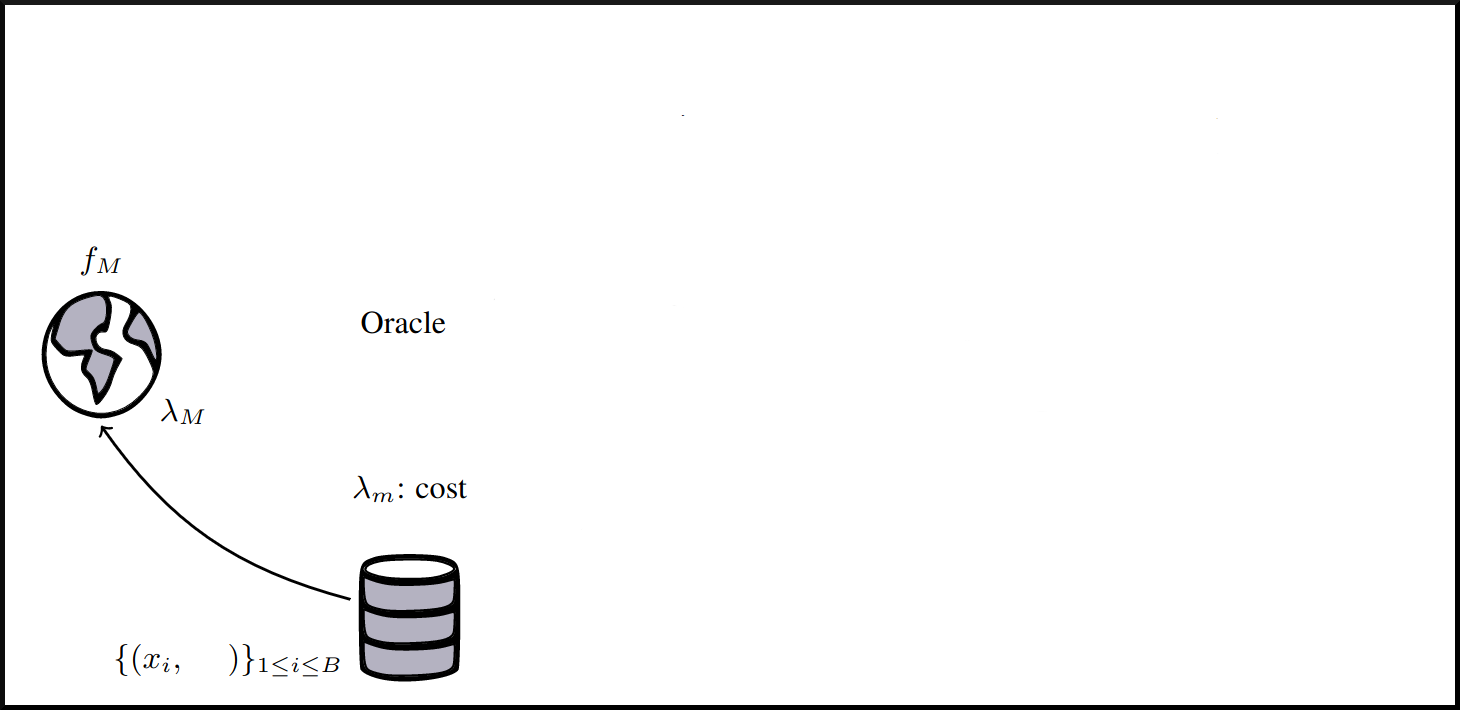] --- count: false ## Our active learning algorithm .center[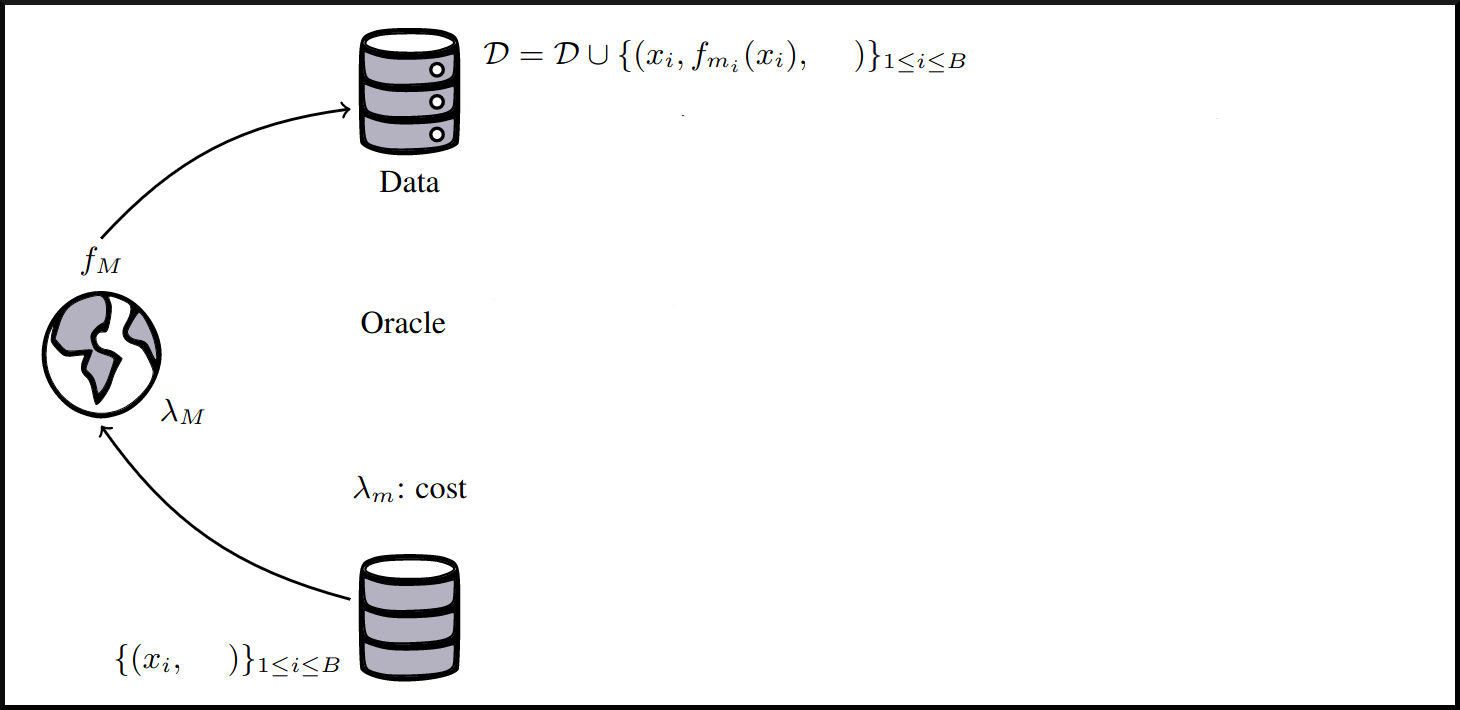] --- count: false ## Our active learning algorithm .center[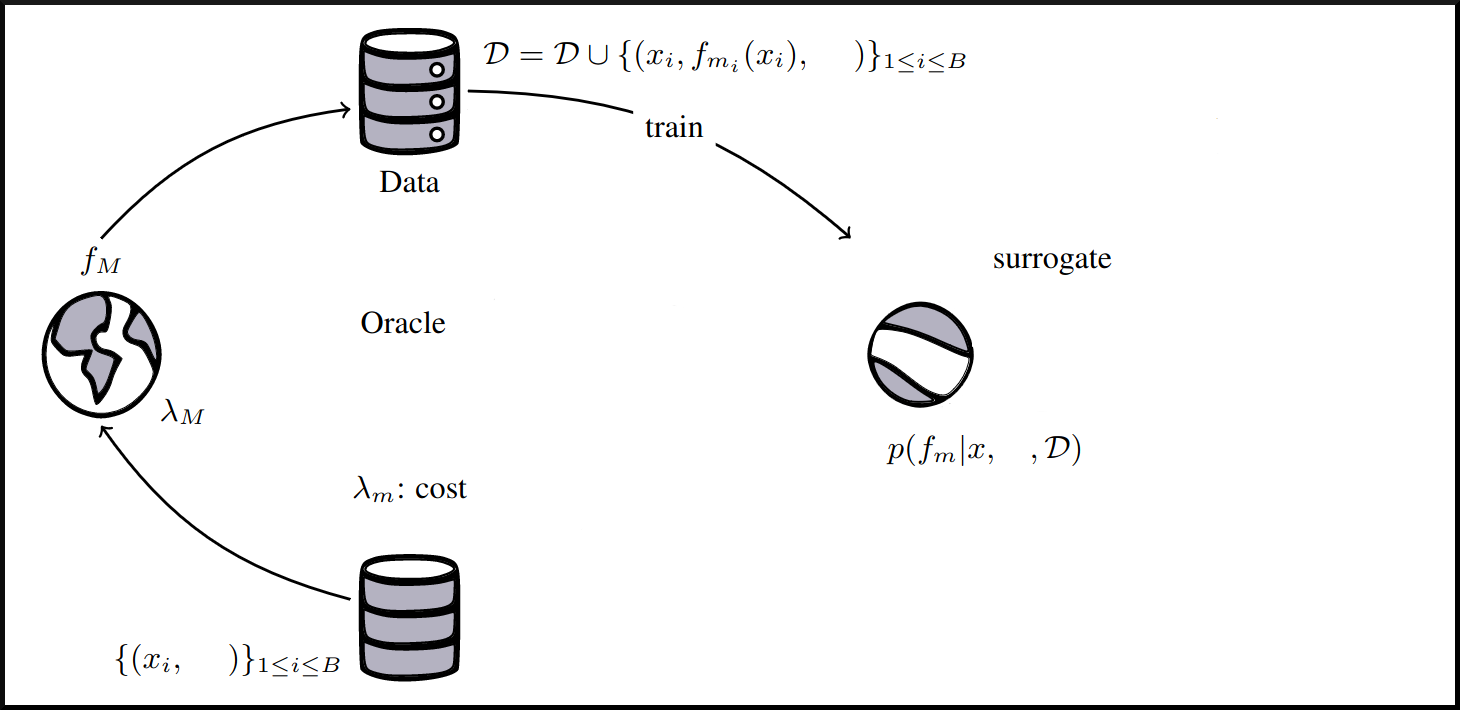] --- count: false ## Our active learning algorithm .center[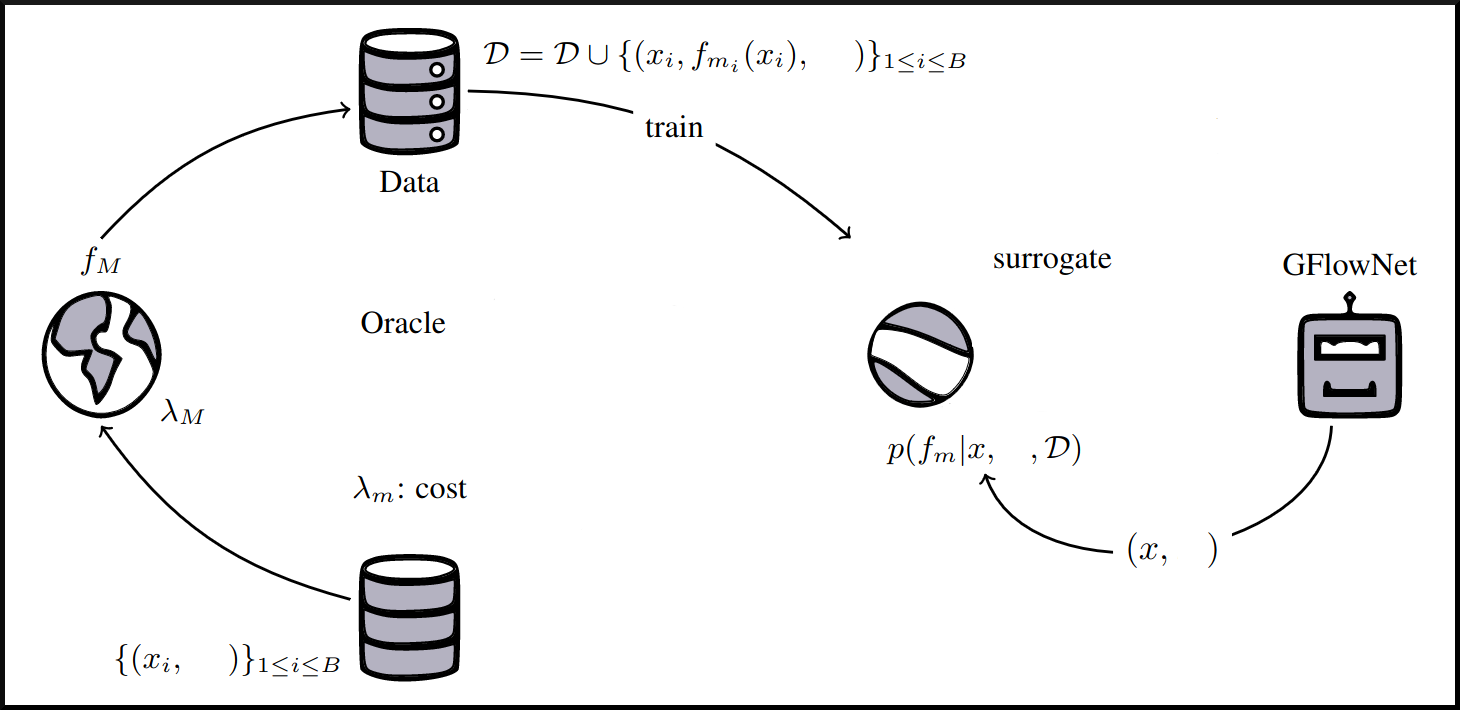] --- count: false ## Our active learning algorithm .center[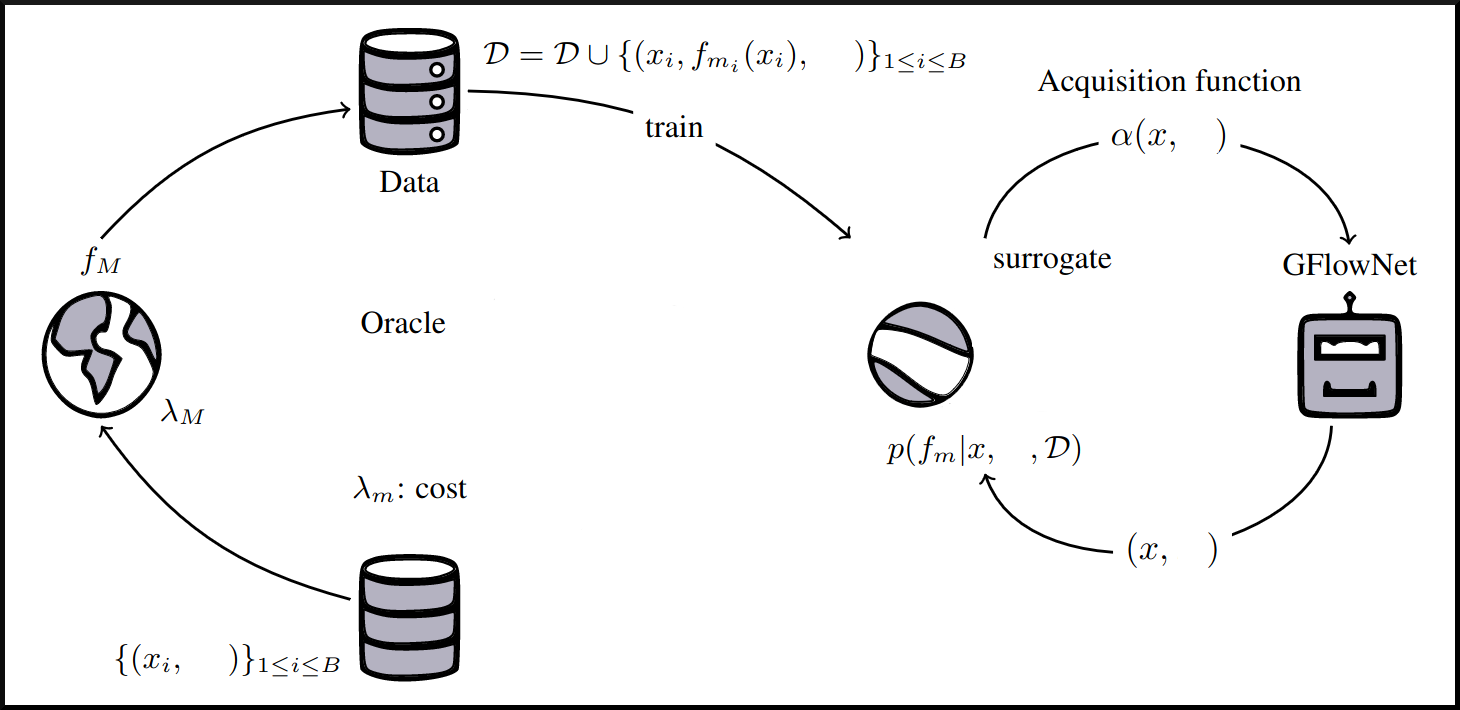] --- count: false ## Our active learning algorithm .center[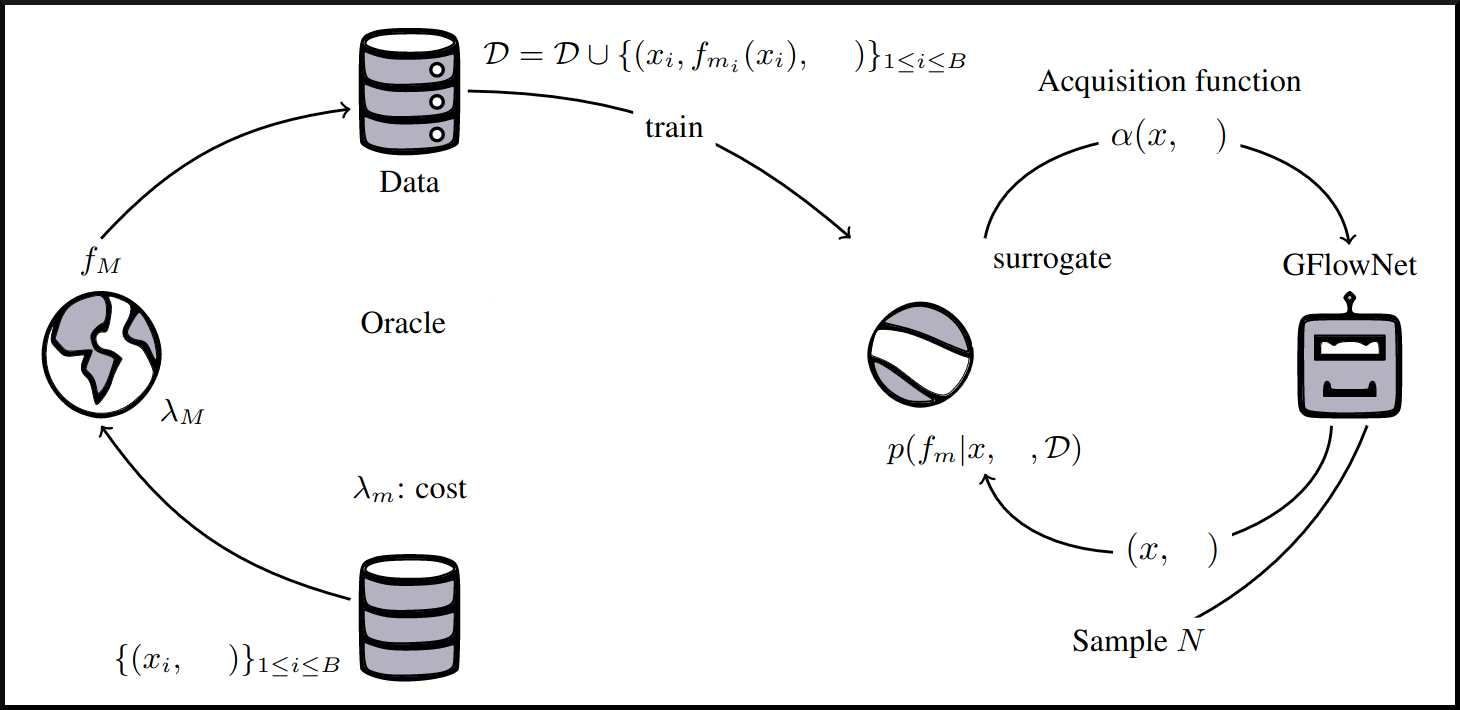] --- count: false ## Our active learning algorithm .center[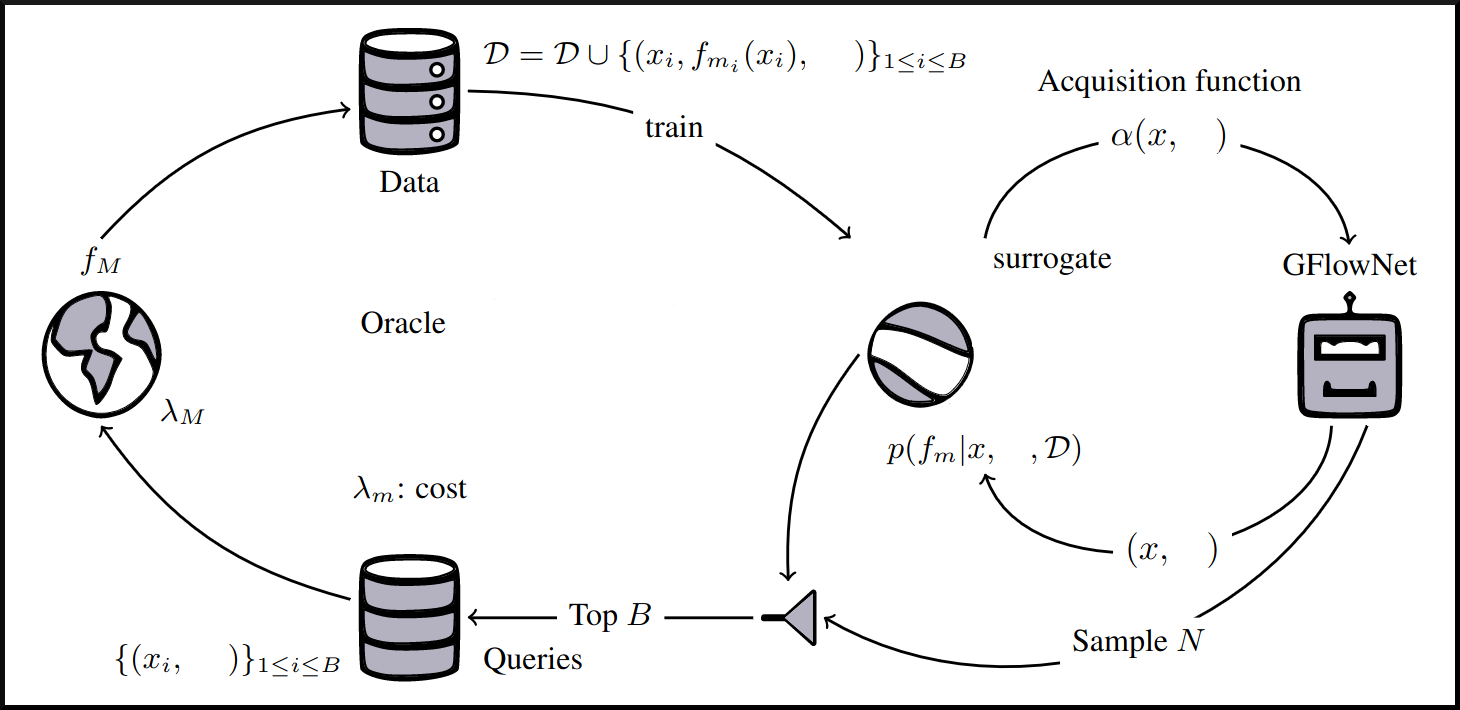] --- count: false ## Our multi-fidelity active learning algorithm .center[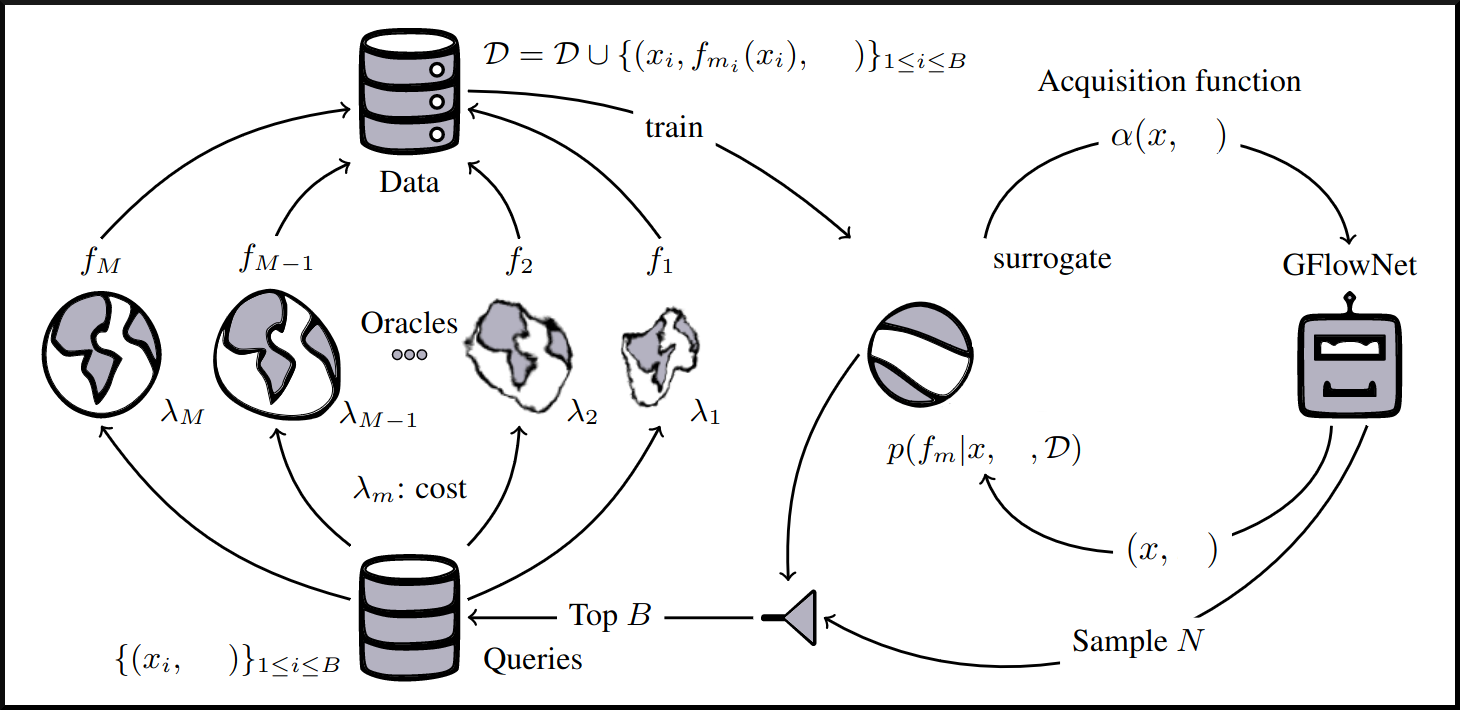] --- count: false ## Our multi-fidelity active learning algorithm .center[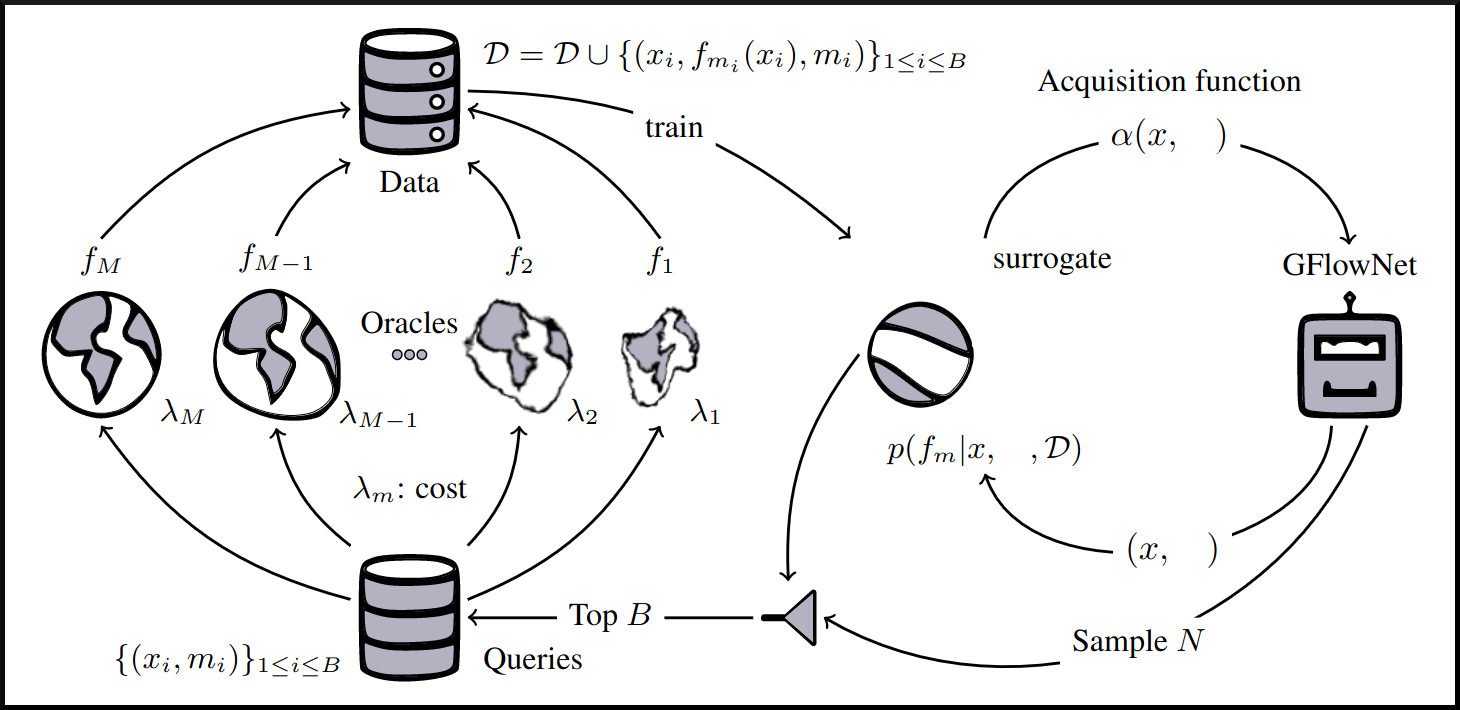] --- count: false ## Our multi-fidelity active learning algorithm .center[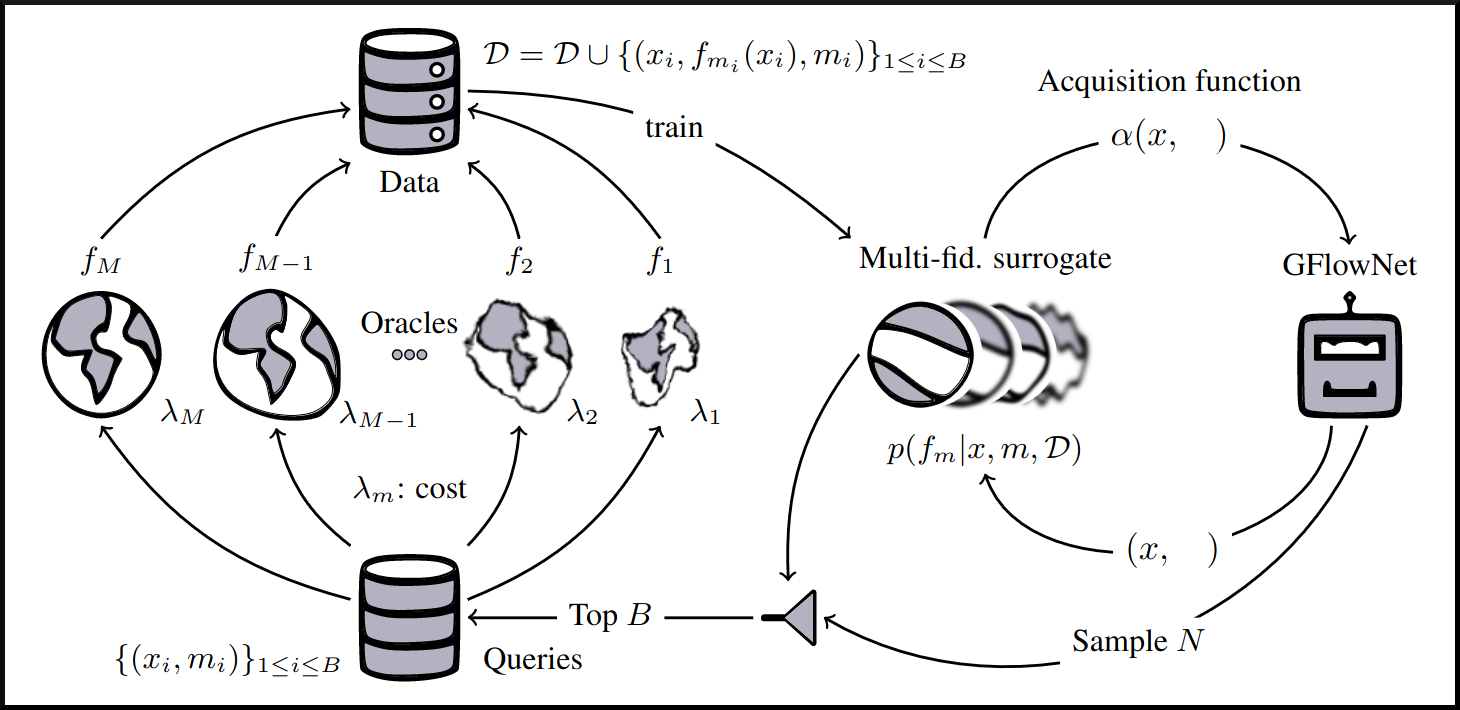] --- count: false ## Our multi-fidelity active learning algorithm .center[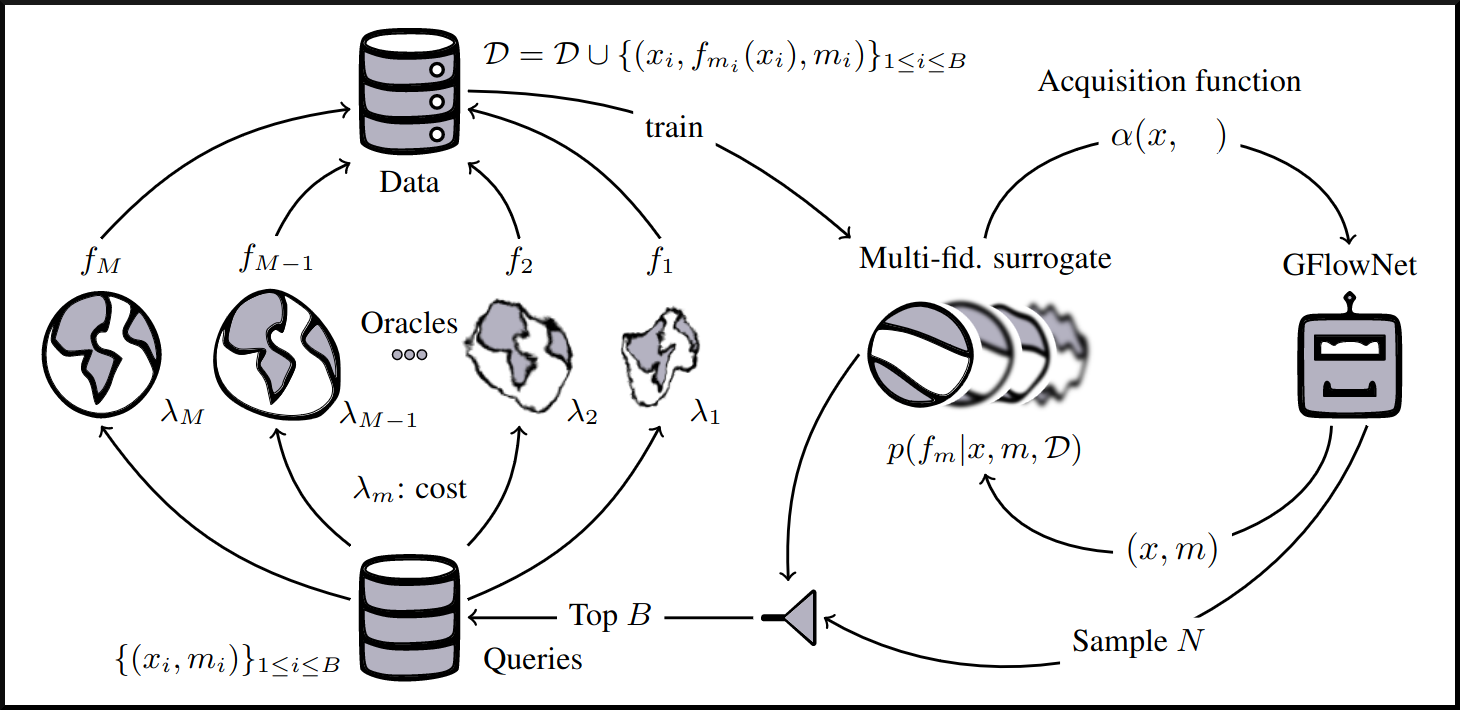] --- count: false ## Our multi-fidelity active learning algorithm .center[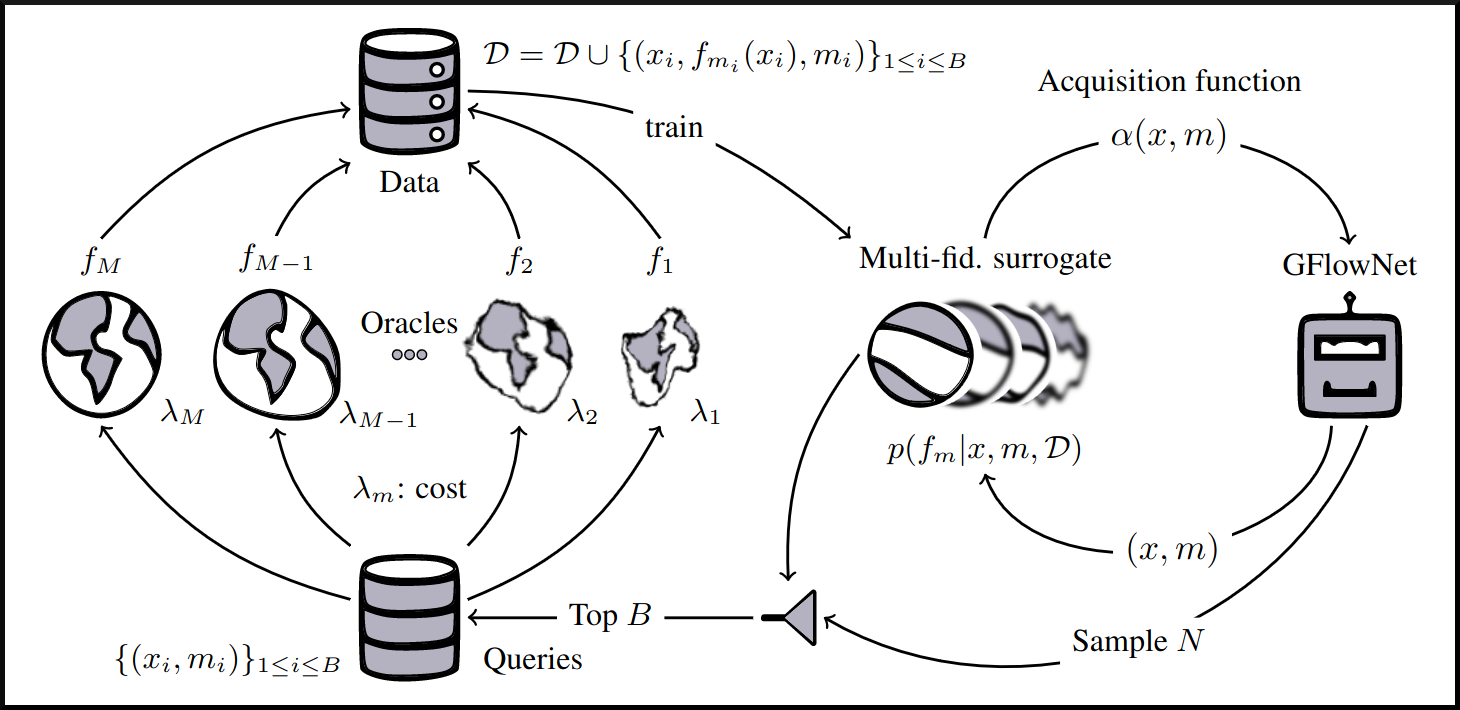] --- ## Experiments ### Baselines .context[This may be the .highlight1[first multi-fidelity active learning algorithm tested on biological sequence design and molecular design problems]. There did not exist baselines from the literature.] -- <br> * .highlight1[SF-GFN]: GFlowNet with highest fidelity oracle to establish a benchmark for performance without considering the cost-accuracy trade-offs. -- * .highlight1[Random]: Quasi-random approach where the candidates and fidelities are picked randomly and the top $(x, m)$ pairs scored by the acquisition function are queried. -- * .highlight1[Random fid. GFN]: GFlowNet with random fidelities, to investigate the benefit of deciding the fidelity with GFlowNets. -- * .highlight1[MF-PPO]: Replacement of MF-GFN with a reinforcement learning algorithm to _optimise_ the acquisition function. --- ## Small molecules - Realistic experiments with experimental oracles and costs that reflect computational demands (1, 3, 7). - GFlowNet adds one SELFIES token (out of 26) at a time with variable length up to 64 ($|\mathcal{X}| > 26^{64}$). - Property: Adiabatic electron affinity (EA). Relevant in organic semiconductors, photoredox catalysis and organometallic synthesis. -- .center[] --- count: false ## Small molecules - Realistic experiments with experimental oracles and costs that reflect computational demands (1, 3, 7). - GFlowNet adds one SELFIES token (out of 26) at a time with variable length up to 64 ($|\mathcal{X}| > 26^{64}$). - Property: Adiabatic electron affinity (EA). Relevant in organic semiconductors, photoredox catalysis and organometallic synthesis. .center[] --- count: false ## Small molecules - Realistic experiments with experimental oracles and costs that reflect computational demands (1, 3, 7). - GFlowNet adds one SELFIES token (out of 26) at a time with variable length up to 64 ($|\mathcal{X}| > 26^{64}$). - Property: Adiabatic electron affinity (EA). Relevant in organic semiconductors, photoredox catalysis and organometallic synthesis. .center[] --- count: false ## Small molecules - Realistic experiments with experimental oracles and costs that reflect computational demands (1, 3, 7). - GFlowNet adds one SELFIES token (out of 26) at a time with variable length up to 64 ($|\mathcal{X}| > 26^{64}$). - Property: Adiabatic electron affinity (EA). Relevant in organic semiconductors, photoredox catalysis and organometallic synthesis. .center[] --- count: false ## Small molecules - Realistic experiments with experimental oracles and costs that reflect computational demands (1, 3, 7). - GFlowNet adds one SELFIES token (out of 26) at a time with variable length up to 64 ($|\mathcal{X}| > 26^{64}$). - Property: Adiabatic electron affinity (EA). Relevant in organic semiconductors, photoredox catalysis and organometallic synthesis. .center[] --- count: false ## Small molecules - Realistic experiments with experimental oracles and costs that reflect computational demands (1, 3, 7). - GFlowNet adds one SELFIES token (out of 26) at a time with variable length up to 64 ($|\mathcal{X}| > 26^{64}$). - Property: Adiabatic electron affinity (EA). Relevant in organic semiconductors, photoredox catalysis and organometallic synthesis. .center[] --- count: false ## Small molecules - Realistic experiments with experimental oracles and costs that reflect computational demands (1, 3, 7). - GFlowNet adds one SELFIES token (out of 26) at a time with variable length up to 64 ($|\mathcal{X}| > 26^{64}$). - Property: Adiabatic electron affinity (EA). Relevant in organic semiconductors, photoredox catalysis and organometallic synthesis. .center[] --- count: false ## Small molecules - Realistic experiments with experimental oracles and costs that reflect computational demands (1, 3, 7). - GFlowNet adds one SELFIES token (out of 26) at a time with variable length up to 64 ($|\mathcal{X}| > 26^{64}$). - Property: Adiabatic .highlight1[ionisation potential (IP)]. Relevant in organic semiconductors, photoredox catalysis and organometallic synthesis. .center[] --- ## DNA aptamers - GFlowNet adds one nucleobase (`A`, `T`, `C`, `G`) at a time up to length 30. This yields a design space of size $|\mathcal{X}| = 4^{30}$. - The objective function is the free energy estimated by a bioinformatics tool. - The (simulated) lower fidelity oracle is a transformer trained with 1 million sequences. -- .center[] --- count: false ## Antimicrobial peptides (AMP) - Protein sequences (20 amino acids) with variable length (max. 50). - The oracles are 3 ML models trained with different subsets of data. -- .center[] --- ## How does multi-fidelity help? .context[Visualisation on the synthetic 2D Branin function task.] .center[] --- count: false ## How does multi-fidelity help? .context[Visualisation on the synthetic 2D Branin function task.] .center[] --- count: false ## How does multi-fidelity help? .context[Visualisation on the synthetic 2D Branin function task.] .center[]